top of page
Ephesus Ancient City
Temple of Serapis in Ephesus
A Monumental Sanctuary Reflecting Religious Diversity in Ephesus Ancient City

The Temple of Serapis in Ephesus was one of the most remarkable religious monuments of Ephesus Ancient City, standing as evidence of the city’s cosmopolitan character and its openness to a wide range of cults during the Roman imperial period. Dedicated to Serapis, a syncretic deity who combined elements of Egyptian and Greco-Roman religious traditions, the temple reveals how Ephesus, Turkey participated in the broader religious networks of the Mediterranean world. The sanctuary’s scale and architectural ambition suggest that the cult of Serapis held considerable importance in the city, especially within an urban environment shaped by trade, migration, and cultural exchange. Its presence demonstrates that Ephesus was not defined only by the famous cult of Artemis, but also by a rich and varied sacred landscape in which multiple traditions could coexist.
Religiously, the Temple of Serapis in Ephesus illustrates the blending of local, imperial, and imported forms of worship that characterized many large Roman cities. Serapis himself was a god associated with healing, fertility, protection, and the afterlife, and his cult appealed to diverse populations across the empire. In Ephesus Ancient City, the temple likely served both ritual and communal functions, creating a space where religious devotion was expressed through architecture, offerings, and ceremonial practice. The sanctuary also reflects the way eastern Mediterranean cities absorbed foreign cults into their civic and spiritual life without entirely replacing older traditions. In a city where the worship of Artemis remained central and the imperial cult also carried political significance, the Temple of Serapis adds another layer to the understanding of Ephesus as a place of religious plurality and cultural interaction.
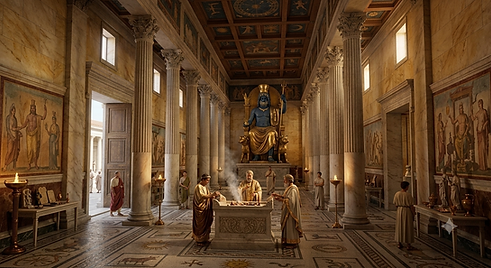

From an archaeological perspective, the Temple of Serapis in Ephesus is important because of its monumental construction and its role within the urban fabric of the city. The surviving architectural remains, including massive building elements and the impressive scale of the podium and entrance area, indicate that this was a sanctuary of exceptional prominence. Its location within the city shows that non-local cults were not marginal, but could become architecturally integrated into the public and ceremonial environment of Ephesus, Turkey. For historians and visitors alike, the temple provides a powerful example of how religion in Ephesus extended beyond a single tradition and reflected the wider interconnected world of the Roman East.
bottom of page