top of page
Ephesus Ancient City
Koressos Gate in Ephesus
A Defensive and Topographical Access Point in Ephesus Ancient City

The Koressos Gate in Ephesus was one of the significant access points within the defensive system of Ephesus Ancient City. Named after Mount Koressos, one of the natural elevations that shaped the city’s setting, the gate occupied an important position in relation to the fortification walls and the surrounding landscape of Ephesus, Turkey. Its location demonstrates how the planners of the city used the natural topography together with built defenses to regulate movement and strengthen protection.
The historical development of the Koressos Gate is closely connected to the Hellenistic reorganization of Ephesus, when the city was relocated and enclosed within an extensive circuit of walls. In this context, gates were not isolated structures but parts of a wider defensive and urban strategy. During later periods, especially under Roman administration, these gateways continued to serve practical and strategic functions, even as the city expanded architecturally and economically. Archaeological remains associated with the gate and nearby wall sections provide evidence for the integration of military planning, road access, and terrain management in Ephesus Ancient City. This makes the gate an important element for understanding how urban boundaries were established and maintained over time.
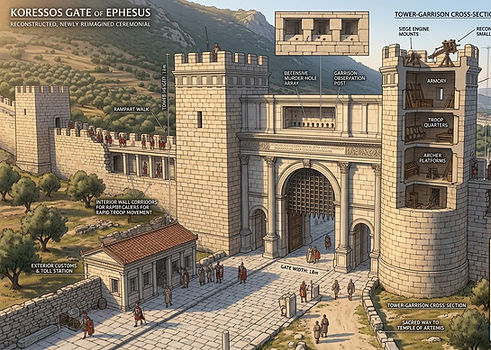

The Koressos Gate in Ephesus is especially valuable because it highlights a side of the city that is less ceremonial but fundamentally important to its historical structure. While monuments such as temples and theaters express civic prestige, gates like this reveal the logistical and defensive framework that supported urban life. As a result, the site contributes to a fuller interpretation of Ephesus, Turkey, showing how geography and fortification shaped the city’s long-term development.
bottom of page